"Smell proof" is a film structure plus a complete seal — not a coating and not a certificate. Here is how odour containment actually works on a mylar pouch, which structures we run, where smell usually escapes, and how to verify the result on your own product.
What actually makes a pouch smell proof
Aroma is carried by volatile organic compounds — small molecules that migrate through materials that look and feel completely solid. On a pouch there are only three paths for them to escape, and every one of them has to be closed:
- Through the film — stopped by a barrier layer in the laminate: metallised PET (VMPET), aluminium foil (AL) or EVOH. This is the layer that does the real work.
- Through the seals — the top, bottom and side seals must be complete and continuous. A bag with a perfect barrier film but a weak back seal still smells.
- Through the zipper — a resealable closure is a mechanical path, so zipper quality and placement matter as much as the film.
So a smell proof pouch is a system: barrier film + correct seal parameters + a closure that reseals tightly. No single layer or spray-on treatment does it alone.
Film structures we run for odour-sensitive products
| Structure | Look and feel | Typical use |
|---|
| PET / VMPET / PE | Metallic sheen, the standard choice | Flower, edibles, coffee, spices |
| PET / AL / PE | Aluminium foil layer, fully opaque, the highest barrier | Long-shelf-life coffee, concentrates, pharma-adjacent products |
| MOPP / VMPET / PE | Matte metallic finish, printable surface | Premium retail packs where a soft-touch matte look sells |
| Kraft paper / VMPET / PE | Kraft paper outside, foil barrier inside | Eco-positioned brands that still need real odour containment |
| PET / EVOH / PE | Transparent with a high oxygen barrier | Products where the customer should see the fill |
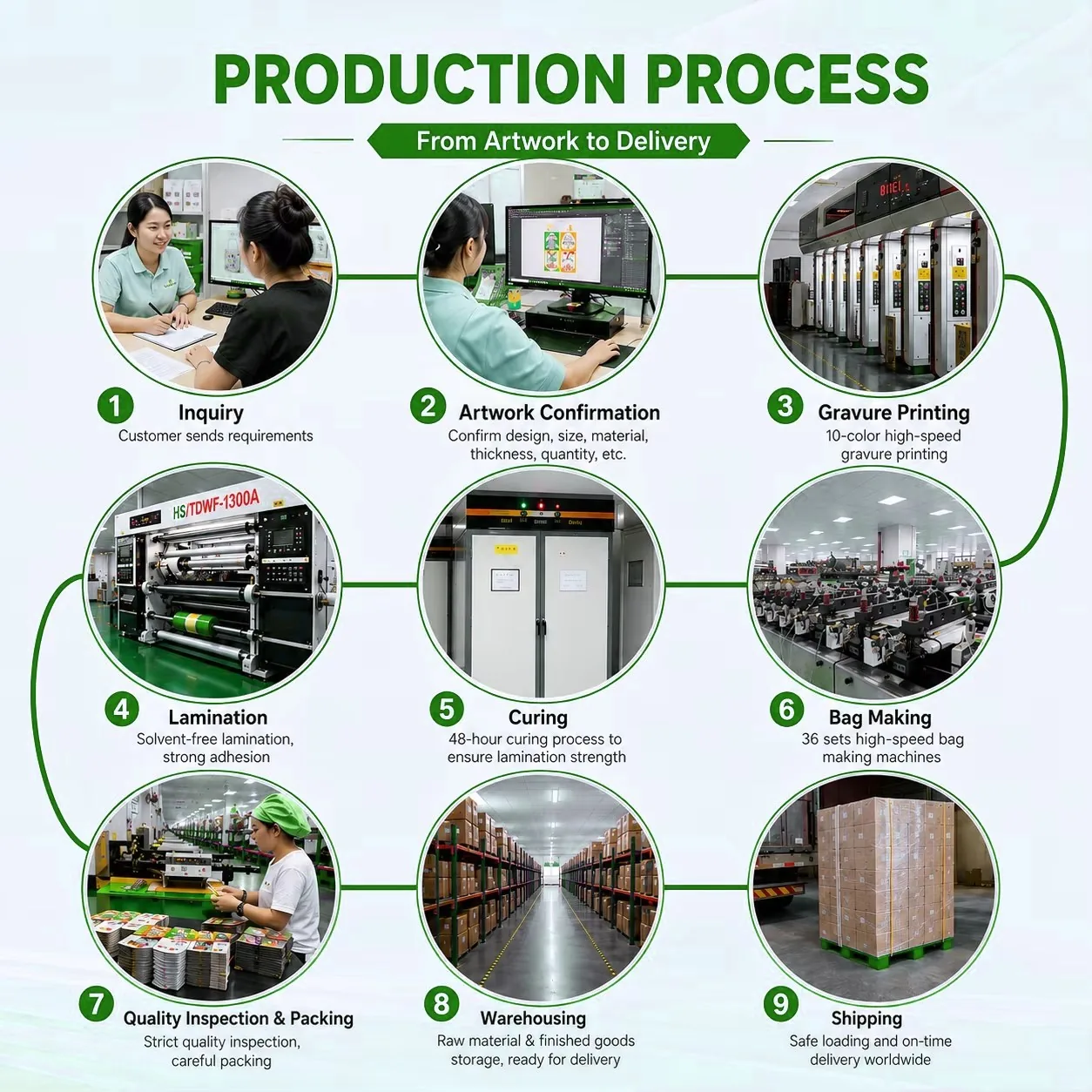
Thickness typically runs 3.5 to 5.5 mil (about 90–140 microns) — a heavier gauge generally means a tougher, higher-barrier pouch, but the structure matters more than thickness alone. Barrier values (WVTR / OTR) for the exact structure you choose are provided with your quote, and we run solvent-free lamination with a 48-hour cure so the layers stay bonded instead of delaminating in transit.
Where smell actually escapes — and how we prevent it
- Weak seals — seal temperature, pressure and dwell time are set per film structure; we check seal integrity on production samples, not just on a first-off bag.
- Poor lamination — if the barrier layer delaminates, odour paths open along the bubbles. The 48-hour curing step exists precisely to prevent this.
- Loose zippers — we use grip-lock zippers designed for resealable aroma containment; a standard slide zipper from a bargain supplier is the most common weak point we see on competitor bags.
- Pinholes in the barrier layer — checked during production; foil layers are the most robust, heavy metallising the most economical.
What we can and cannot claim
We keep this blunt, the same way we do on the child-resistant page: there is no industry-wide "smell proof certificate" for flexible packaging. Odour containment is a design target, proven by testing the actual filled pouch, not a paper property.
- We do: build the pouch on a true barrier structure, hold the seal and lamination quality in production, and supply samples for your own fill-and-hold test — fill it, seal it, leave it in a closed drawer for a week and judge with your own nose.
- We do not: write "certified smell proof" on your artwork or imply a test we did not run. That kind of claim is on you, and in most markets it is also a legal exposure for the brand.
Features that combine with a smell proof structure
- CR zipper — child-resistant and resealable, for markets that require it: child-resistant mylar bags
- One-way degassing valve — for freshly roasted coffee that needs to vent CO₂ without letting air in
- Tear notch and heat-seal top — tamper-evident first opening
- Clear window — possible, but a window always trades some barrier for visibility; we will tell you honestly what it costs in performance
What to send us for a quote
- Product and fill weight (or a target size from the size chart)
- Quantity per design — custom printed starts at 500 pieces
- Structure preference, or just tell us the product and we propose one
- Zipper type: standard resealable, CR, or none (heat seal only)
- Artwork — a logo or a sketch is enough, our design service is free
Send it on WhatsApp and we reply with pricing and a dieline, usually within 24 hours.
Price and lead time
As a reference, a 3.5 g matte stand-up pouch with a standard zipper runs US$0.60 per bag at 500 pieces, US$0.33 at 1,000 and US$0.16 at 3,000 — foil and higher-barrier structures are quoted on top, confirmed in your quote. Production takes about 3 to 10 days after artwork approval, and every order is sampled before the bulk run.
More on how printing and structure drive the price: custom printed mylar bags — options and pricing.
Sources and standards
Primary references for the barrier and food-contact properties discussed on this page:
Quick answers
The questions buyers ask most about this.
Are your mylar bags really smell proof?
The film structures we use are true high-barrier laminates (VMPET, aluminium foil or EVOH with complete seals), which is what odour containment requires. But "smell proof" is a design target, not a certificate — we supply samples so you can run a fill-and-hold test on your own product before the bulk run.
Which structure is best for coffee or flower?
For coffee we usually recommend PET/AL/PE with an optional one-way degassing valve. For flower and edibles, PET/VMPET/PE with a resealable zipper is the standard, and a CR zipper if your market requires child resistance. Tell us the product and we propose the structure in the quote.
Can I get a smell proof bag with a clear window?
Yes, but a window trades some barrier for visibility because the film is opened up in that area. For maximum odour containment we suggest a fully opaque structure; if shelf visibility matters more, PET/EVOH/PE gives you transparency with a high oxygen barrier.
What is the MOQ?
Custom printed pouches start at 500 pieces per design. Ready-made stock bags start at 200 pieces.
Do you have a smell-proof certificate?
No — and be careful with any supplier who claims one. There is no industry-wide smell proof certification for flexible packaging. What we provide is the barrier structure, production quality and samples you can test yourself, plus barrier values (WVTR/OTR) for the chosen structure.
How much do smell proof mylar bags cost?
A 3.5 g matte stand-up pouch with a standard zipper runs US$0.60 at 500 pieces down to US$0.16 at 3,000; foil and higher-barrier structures are quoted on top. Send product, size and quantity and we reply with exact pricing, usually within 24 hours.
 Sainsun Mylar Bags